Challenge
Soon after I joined a growing retirement benefits company, a team came to me because they couldn’t fully picture the onboarding experience their system was delivering. They described a two-part problem:
- We have two tiers of onboarding that happen over months (B2B2C, or a client company and its employees), and many email alerts being triggered by the system. The system works, but client feedback and KPIs indicate some confusion. We need it to work better as we grow.
- Operations wants to audit the transactional emails that get sent throughout the onboarding journey, Content wants to revise the copy and get Compliance to review and sign off, but first we have to find and log every message our system sends.
I recommended a modified service blueprint to help the team find and map the onboarding messages.
Approach
The framework
A service blueprint separates “front of house” (what the client actually sees and experiences) from “back of house” systems running behind the scenes. The original project artifact is confidential, so this simplified sample illustrates the classic ingredients: customer actions, frontstage interactions, backstage work and supporting processes. My version modified that framework with a dedicated swimlane for holding the messages we were gathering.
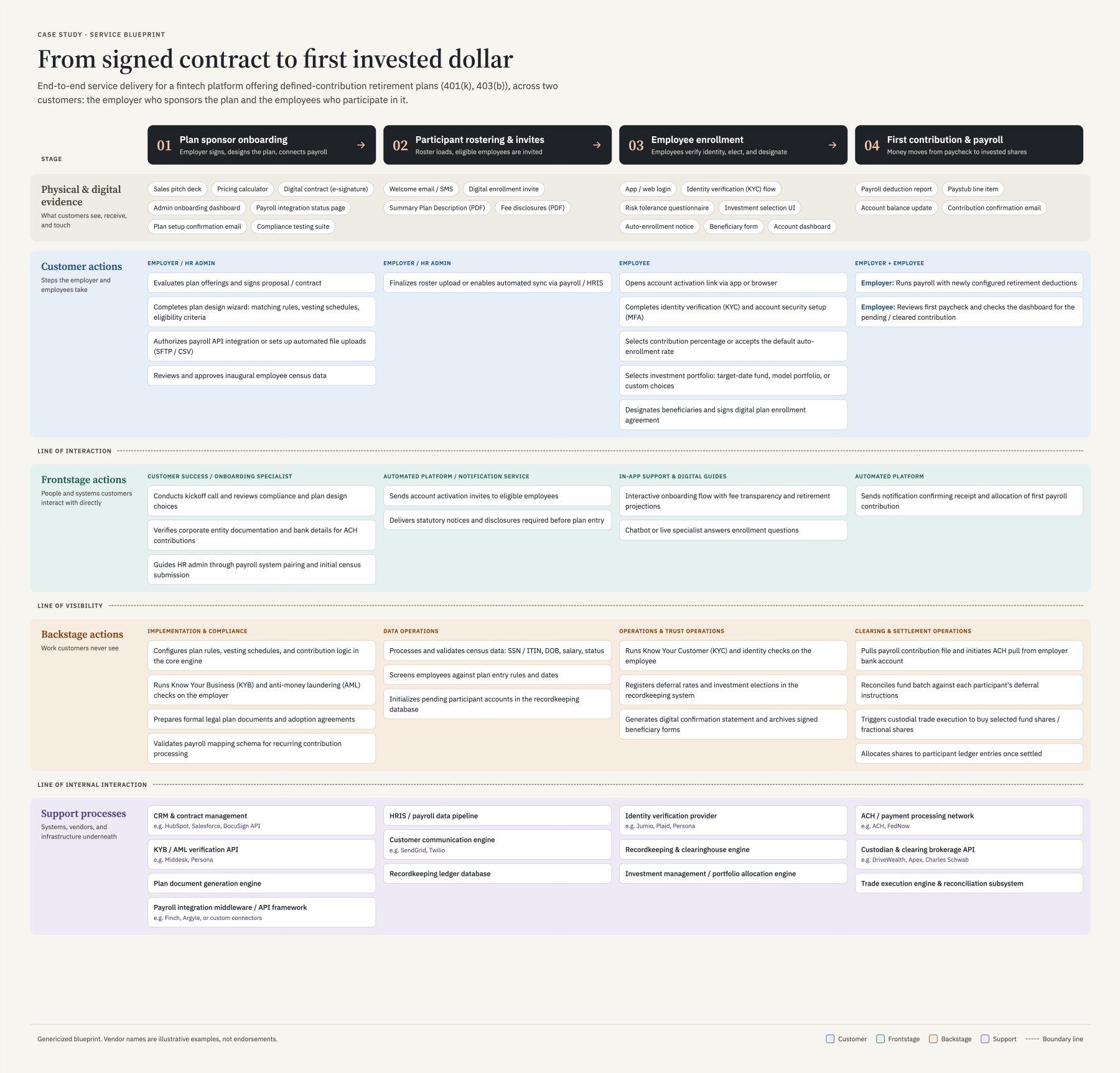
View full-size blueprint (PDF) · Explore the blueprint by stage
Fun fact: Service blueprints were first introduced by G. Lynn Shostack in a 1984 article in the Harvard Business Review. Over the years, they’ve been used and adapted across a wide range of industries and government services.
Putting it all together
I set up a template on an online whiteboard (in this case, Miro), with a column for each onboarding step and swimlanes for channels, actors and messages. I used a flexible table so any cell could grow as more messages were discovered.
Armed with that, I sat down with the Operations analyst to go over the plan. In one meeting, we set up the board, clarified the evidence he’d need to gather and scheduled a progress review. Gathering the evidence was harder: the analyst had to ask each engineering team for the triggers and email content buried in our code.
Impact
The blueprint made the system’s onboarding messages visible in one place, giving the team a shared view they could use to begin improving the process.
The takeaway
If I revisited this project today, I’d investigate whether coding agents could help extract the messages and keep the blueprint current.
Interested in working together? Get in touch.